Showing posts with label wonder of world. Show all posts

Monday, December 17, 2012

The Taj Mahal


The Taj Mahal

The Taj Mahal in Agra India
Located at the city of Agra in the State of Uttar Pradesh, the Taj Mahal is one of the most beautiful masterpieces of architecture in the world. Agra, situated about 200 km south of New Delhi, was the Capital of the Mughals (Moguls), the Muslim Emperors who ruled Northern India between the sixteenth and nineteenth centuries. The Mughals were the descendents of two of the most skilled warriors in history: the Turks and the Mongols. The Mughal dynasty reached its highest strength and fame during the reign of their early Emperors, Akbar, Jehangir, and Shah Jehan.
It was Shah Jehan who ordered the building of the Taj, in honor of his wife, Arjumand Banu who later became known as Mumtaz Mahal, the Distinguished of the Palace. Mumtaz and Shah Jehan were married in 1612 and, over the next 18 years, had 14 children together. The Empress used to accompany her husband in his military campaigns, and it was in 1630, in Burhanpur, that she gave birth to her last child, for she died in childbirth. So great was the Emperor love to his wife that he ordered the building of the most beautiful mausoleum on Earth for her.
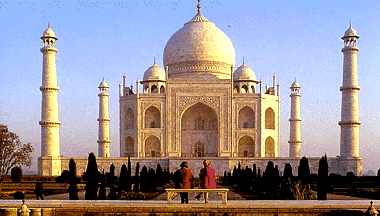
Although it is not known for sure who planned the Taj, the name of an Indian architect of Persian descent, Ustad Ahmad Lahori, has been cited in many sources. As soon as construction began in 1630, masons, craftsmen, sculptors, and calligraphers were summoned from Persia, the Ottoman Empire, and Europe to work on the masterpiece. The site was chosen near the Capital, Agra on the southwest bank of the River Yamuna. The architectural complex is comprised of five main elements: the Darwaza or main gateway, the Bageecha or garden, the Masjid or mosque, the Naqqar Khana or rest house, and the Rauza or the Taj Mahal mausoleum. The actual Tomb is situated inside the Taj.
The unique mughal style combines elements of Persian, Central Asian, and Islamic architecture. Most impressive are the black and white chessboard marble floor, the four tall minarets (40 m high) at the corners of the structure, and the majestic dome in the middle. On closer look, the lettering of the Quran verses around the archways appears to be uniform, regardless of their height. The lettering spacing and density has been customized to give this impression to the beholder. Other illusionary effects have been accounted for in the geometry of the tomb and the tall minarets. The impressive pietra dura artwork includes geometric elements, plants and flowers, mostly common in Islamic architecture. The level of sophistication in artwork becomes obvious when one realizes that a 3 cm decorative element contains more than 50 inlaid gemstones.

The Hanging Gardens of Babylon


The Hanging Gardens of Babylon

The Hanging Gardens of Babylon
Fruits and flowers... Waterfalls... Gardens hanging from the palace terraces... Exotic animals... This is the picture of the Hanging Gardens of Babylon in most people's minds. It may be surprising to know that they might have never existed except in Greek poets and historians imagination!
Location
On the east bank of the River Euphrates, about 50 km south of Baghdad, Iraq.
History
The Babylonian kingdom flourished under the rule of the famous King, Hammurabi (1792-1750 BC). It was not until the reign of Naboplashar (625-605 BC) of the Neo-Babylonian dynasty that the Mesopotamian civilization reached its ultimate glory. His son, Nebuchadnezzar II (604-562 BC) is credited for building the legendary Hanging Gardens. It is said that the Gardens were built by Nebuchadnezzar to please his wife or concubine who had been "brought up in Media and had a passion for mountain surroundings".
While the most descriptive accounts of the Gardens come from Greek historians such as Berossus and Diodorus Siculus, Babylonian records stay silent on the matter. Tablets from the time of Nebuchadnezzar do not have a single reference to the Hanging Gardens, although descriptions of his palace, the city of Babylon, and the walls are found. Even the historians who give detailed descriptions of the Hanging Gardens never saw them. Modern historians argue that when Alexander's soldiers reached the fertile land of Mesopotamia and saw Babylon, they were impressed. When they later returned to their rugged homeland, they had stories to tell about the amazing gardens and palm trees at Mesopotamia.. About the palace of Nebuchadnezzar.. About the Tower of Babel and the ziggurats. And it was the imagination of poets and ancient historians that blended all these elements together to produce one of the World Wonders.
It wasn't until the twentieth century that some of the mysteries surrounding the Hanging Gardens were revealed. Archaeologists are still struggling to gather enough evidence before reaching the final conclusions about the location of the Gardens, their irrigation system, and their true appearance.
Description
Detailed descriptions of the Gardens come from ancient Greek sources, including the writings of Strabo and Philo of Byzantium. Here are some excerpts from their accounts:
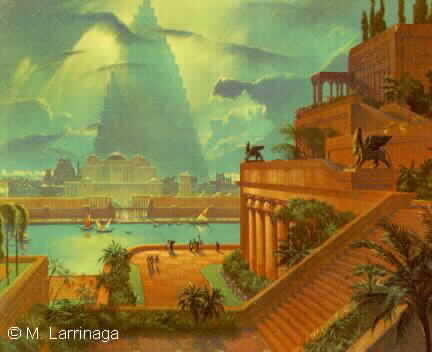
"The Garden is quadrangular, and each side is four plethra long. It consists of arched vaults which are located on checkered cube-like foundations.. The ascent of the uppermost terrace-roofs is made by a stairway..."
"The Hanging Garden has plants cultivated above ground level, and the roots of the trees are embedded in an upper terrace rather than in the earth. The whole mass is supported on stone columns... Streams of water emerging from elevated sources flow down sloping channels... These waters irrigate the whole garden saturating the roots of plants and keeping the whole area moist. Hence the grass is permanently green and the leaves of trees grow firmly attached to supple branches... This is a work of art of royal luxury and its most striking feature is that the labor of cultivation is suspended above the heads of the spectators".
More recent archaeological excavations at the ancient city of Babylon in Iraq uncovered the foundation of the palace. Other findings include the Vaulted Building with thick walls and an irrigation well near the southern palace. A group of archaeologists surveyed the area of the southern palace and reconstructed the Vaulted Building as the Hanging Gardens. However, the Greek historian Strabo had stated that the gardens were situated by the River Euphrates. So others argue that the site is too far from the Euphrates to support the theory since the Vaulted Building is several hundreds of meters away. They reconstructed the site of the palace and located the Gardens in the area stretching from the River to the Palace. On the river banks, recently discovered massive walls 25 m thick may have been stepped to form terraces... the ones described in Greek references.

the great pyramid of giza


                             The Great Pyramid Of Giza

The Great Pyramid of Giza
It is the one and only Wonder which does not require a description by early historians and poets. It is the one and only Wonder that does not need speculations concerning its appearance, size, and shape. It is the oldest, yet it is the only surviving of the Seven Ancient Wonders. It is the Great Pyramid of Giza.
Location:
At the city of Giza, a necropolis of ancient Memphis, and today part of Greater Cairo, Egypt.
History
Contrary to the common belief, only the Great Pyramid of Khufu (Cheops), not all three Great Pyramids, is on top of the list of Wonders. The monument was built by the Egyptian pharaoh Khufu of the Fourth Dynasty around the year 2560 BC to serve as a tomb when he dies. The tradition of pyramid building started in Ancient Egypt as a sophistication of the idea of a mastaba or "platform" covering the royal tomb. Later, several stacked mastabas were used. Early pyramids, such as the Step Pyramid of King Zoser (Djoser) at Saqqara by the famous Egyptian architect, Imhotep, illustrate this connection.
The great pyramid is believed to have been built over a 20 year period. The site was first prepared, and blocks of stone were transported and placed. An outer casing (which disappeared over the years) was then used to smooth the surface. Although it is not known how the blocks were put in place, several theories have been proposed. One theory involves the construction of a straight or spiral ramp that was raised as the construction proceeded. This ramp, coated with mud and water, eased the displacement of the blocks which were pushed (or pulled) into place. A second theory suggests that the blocks were placed using long levers with a short angled foot.
Throughout their history, the pyramids of Giza have stimulated human imagination. They were referred to as "The Granaries of Joseph" and "The Mountains of Pharaoh". When Napoleon invaded Egypt in 1798, his pride was expressed through his famous quote: "Soldats! Du haute de ces Pyramides, 40 siècles nous contemplent". (Soldiers! From the top of these Pyramids, 40 centuries are looking at us)
Today, the Great Pyramid is enclosed, together with the other pyramids and the Sphinx, in the touristic region of the Giza Plateau. Also in the area is the museum housing the mysterious Sun Boat, only discovered in 1954 near the south side of the pyramid. The boat is believed to have been used to carry the body of Khufu in his last journey on earth before being buried inside the pyramid. It may also serve him as a means of transportation in his afterlife journey according to Ancient Egyptian beliefs.
Description
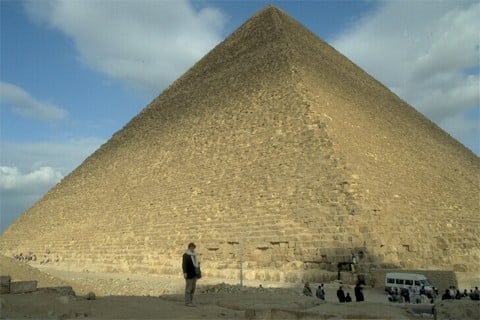
When it was built, the Great pyramid was 145.75 m (481 ft) high. Over the years, it lost 10 m (30 ft) off its top. It ranked as the tallest structure on Earth for more than 43 centuries, only to be surpassed in height in the nineteenth century AD. It was covered with a casing of stones to smooth its surface (some of the casing can still be seen near the top of Khefre's pyramid). The sloping angle of its sides is 54 degrees 54 minutes. Each side is carefully oriented with one of the cardinal points of the compass, that is, north, south, east, and west. The horizontal cross section of the pyramid is square at any level, with each side measuring 229 m (751 ft) in length. The maximum error between side lengths is astonishingly less than 0.1%.
The structure consists of approximately 2 million blocks of stone, each weighing more than two tons. It has been suggested that there are enough blocks in the three pyramids to build a 3 m (10 ft) high, 0.3 m (1 ft) thick wall around France. The area covered by the Great pyramid can accommodate St Peter's in Rome, the cathedrals of Florence and Milan, and Westminster and St Paul's in London combined.
On the north face, is the pyramid's entrance. A number of corridors, galleries, and escape shafts either lead to the King's burial chamber, or were intended to serve other functions. The King's chamber is located at the heart of the pyramid, only accessible through the Great Gallery and an ascending corridor. The King's sarcophagus is made of red granite, as are the interior walls of the King's Chamber. Most impressive is the sharp-edged stone over the doorway which is over 3 m (10 ft) long, 2.4 m (8 feet) high and 1.3 m (4 ft) thick. All of the interior stones fit so well, a card won't fit between them. The sarcophagus is oriented in accordance with the compass directions, and is only about 1 cm smaller in dimensions than the chamber entrance. It might have been introduced as the structure was progressing.
New theories concerning the origin and purpose of the Pyramids of Giza have been proposed... Astronomic observatories... Places of cult worship... Geometric structures constructed by a long-gone civilization... Even extraterrestrial-related theories have been proposed with little evidence in support... The overwhelming scientific and historic evidence still supports the conclusion that, like many smaller pyramids in the region, the Great Pyramids were built by the great Ancient Egyptian civilization off the West bank of the Nile as tombs for their magnificent Kings... Tombs where Khufu, Khefre, and Menkaure could start their mystic journey to the afterlife.